Good Vibe Handwritten Font for Makers
It was 10 p.m., candle wax still drying on my workbench, and I was tweaking the final label for a new lavender-vanilla soy candle—my bestseller. The design felt flat until I swapped in Good Vibe. Instantly, the label softened, warmed, and whispered “hand-poured with care.” That’s when I knew: Good Vibe isn’t just another Display font—it’s a quiet collaborator in handmade storytelling.
Good Vibe for Wedding Invitations and Elegant Branding
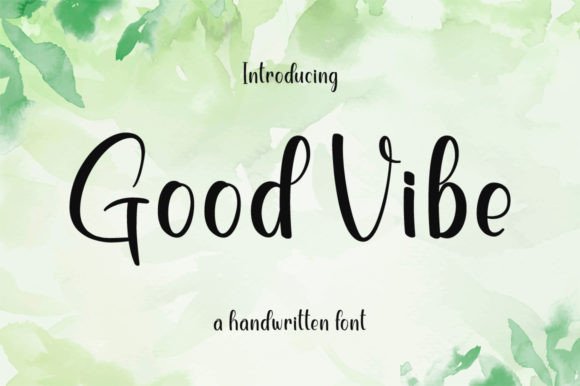
I tested Good Vibe across three real wedding stationery sets: digital save-the-dates, printed pocket-fold invitations, and acrylic welcome signage. As a handwritten font, it balances playfulness and polish—no wobbly inconsistency or overdone flourishes. The letterforms have gentle contrast, subtle entry/exit strokes, and natural rhythm that reads as human but never messy. On ivory cotton paper, Good Vibe shines brightest at 24–48 pt for names and headers; it holds crispness even when laser-printed or foil-stamped. Pair it with a clean sans serif (like Montserrat Light) for body text, and you’ve got timeless elegance without sacrificing warmth. Because Good Vibe is a Display font—not meant for paragraphs—it’s perfect for monogrammed envelopes, RSVP cards, and delicate quote callouts (“Love grows here,” “Forever begins now”). Just avoid using it for fine-print details like venue addresses or registry footers.
Good Vibe for Greeting Cards and Thank You Cards That Feel Personal
My weekly batch of hand-assembled greeting cards lives or dies by authenticity—and Good Vibe delivers. I used it for birthday cards (“You’re the *real* MVP”), sympathy notes (“Holding you gently”), and thank you cards for wholesale partners. What surprised me? How well it scales down to 16–18 pt without losing legibility—even on matte-finish cardstock. The spacing between letters feels intentional, not cramped, and lowercase “a,” “g,” and “y” have charming, open shapes that invite the eye. As a Fonts choice for physical cards, Good Vibe adds tactile warmth that generic scripts can’t match. For Cricut and Silhouette users: it cuts cleanly at 1.25" height on vinyl, especially with a slight stroke outline enabled. Pro tip: test your cut settings first on scrap material—the swashes are graceful, not fragile, but very fine terminals may need a 0.5 pt stroke for durability on small stickers or tags.
Good Vibe for Printable Wall Art and Digital Downloads
When designing printable wall art for a spring collection—think minimalist botanical quotes and affirmations—I reached for Good Vibe again. Its friendly confidence makes phrases like “Bloom where you’re planted” feel uplifting, not cutesy. As a handwritten font, it gives digital files instant charm and perceived value—customers consistently comment that prints “look professionally designed, not DIY.” For Etsy listings, I use Good Vibe in mockups for title banners and quote overlays. It renders beautifully on screen (no pixelation), and because it’s a well-hinted Display font, it stays smooth at all sizes in PDF previews. Bonus: the included OTF files support standard Latin characters and basic punctuation—perfect for English-language printables, planner pages, and social media quote graphics. Just double-check licensing before bundling into Canva templates or editable Google Slides—if your commercial license covers template resale, Good Vibe becomes an asset, not just decoration.
Good Vibe for Product Labels, Boutique Tags, and Packaging Design
This is where Good Vibe truly earns its keep. I applied it to kraft paper soap labels, linen gift tags, and reusable cotton tote bag prints—and each time, the font elevated perceived craftsmanship. On curved surfaces (like apothecary jars), Good Vibe’s organic flow mimics hand-lettering far better than rigid scripts. It works best for short, high-impact words: “Oat & Honey,” “Small Batch,” “Made With Love.” Avoid cramming ingredient lists or certifications into Good Vibe; its decorative nature means readability drops below 10 pt or in dense blocks. For packaging, I pair it with a sturdy, neutral sans serif (like Inter or Lato) for functional text—this contrast builds visual hierarchy while keeping brand voice cohesive. And yes—it’s SVG-friendly! I exported Good Vibe-based designs straight into Cricut Design Space for iron-on transfers on mugs and tees, and the curves stayed smooth, no jagged edges.
Good Vibe for Logos, Business Cards, and Shop Identity That Stands Out
Your logo is your handshake. Your business card is your first impression. And Good Vibe makes both feel warmly intentional—not trendy, not sterile, but unmistakably *yours*. I used it to refresh my own shop’s logo lockup (paired with a thin geometric sans for balance), then carried it through business cards, Instagram story highlights, and even my Etsy shop banner. As a Display font, Good Vibe commands attention without shouting. It’s versatile enough for a farmhouse boutique, a mindful wellness brand, or a joyful kids’ product line—because its personality is friendly, not fixed. Before finalizing, I checked the file package: full OpenType support, standard ligatures, and stylistic alternates (like a swash capital “G”) that add subtle polish. No extra weights—but that’s ideal for a handwritten font: one expressive weight does the work beautifully. Just remember—Good Vibe thrives in moments of emphasis, not explanation. Let it headline. Let it sign off. Let it make people pause, smile, and remember.